Prove a control held every day of the period, not just today
Auditors do not ask what your cloud looks like right now. They ask what it looked like in March. imPAC keeps the full evaluated history of your AWS, Azure, and GCP configuration, so GRC pulls sealed evidence directly instead of opening tickets to engineering. Cut the evidence cycle from 2 to 4 weeks down to 2 hours for 80 percent of checks.
Built for GRC leads, compliance analysts, and internal audit teams at regulated enterprises.
- 2 hours
- evidence cycle for 80% of checks, down from 2 to 4 weeks
- 1 to 2
- GRC analysts needed, with no engineering tickets
- Hashed
- every export carries a verification endpoint
- Any date
- reconstruct control state for any day retained
Your evidence expires the moment you capture it.
A screenshot proves one control passed on one afternoon. An audit asks whether it held for six months. Most teams close that gap with engineering tickets, one-off scripts, and a folder of images that nobody can independently verify. That process is slow, it pulls senior engineers off roadmap work, and it produces evidence an assessor is entitled to be skeptical of.
GRC cannot answer its own questions
Every evidence request becomes a ticket. The analyst who owns the control cannot see the configuration behind it, so they wait on Cloud Ops for each ask and each auditor follow-up. A single audit cycle can generate dozens of these round trips, and the engineers fulfilling them are the same people you need on delivery work.
Point-in-time proof does not survive a period question
The field question we hear verbatim: show evidence that all production resources over the last six months that held PII were encrypted, had backups configured, and had recently rotated keys. A posture tool answers the encrypted part, for today. It cannot answer the last six months part at all, because it never kept the prior states.
Screenshots are evidence an assessor can dismiss
An image in a slide deck has no provenance. Nothing about it proves when it was taken, whether it was edited, or whether the environment it describes still exists. As assessors get stricter about evidence integrity, the format itself becomes the finding.
From control to sealed evidence in four steps
Map the control, give GRC direct read access, validate across the period, then export something an assessor can verify independently.
Frameworks map to the same underlying cloud asset inventory. ISO 27001, SOC 2, and NIST are sets of controls inside the platform you already run, not separate platforms. Your internal standards absorb the same way, so a custom control your auditor cares about is treated no differently from a framework control.
Analysts get scoped, read-only configuration data across every cloud account, with saved views that answer the requests you get every cycle. Roughly 80 percent of evidence asks become self-serve. The remaining 20 percent are the genuinely novel questions worth an engineer's time.
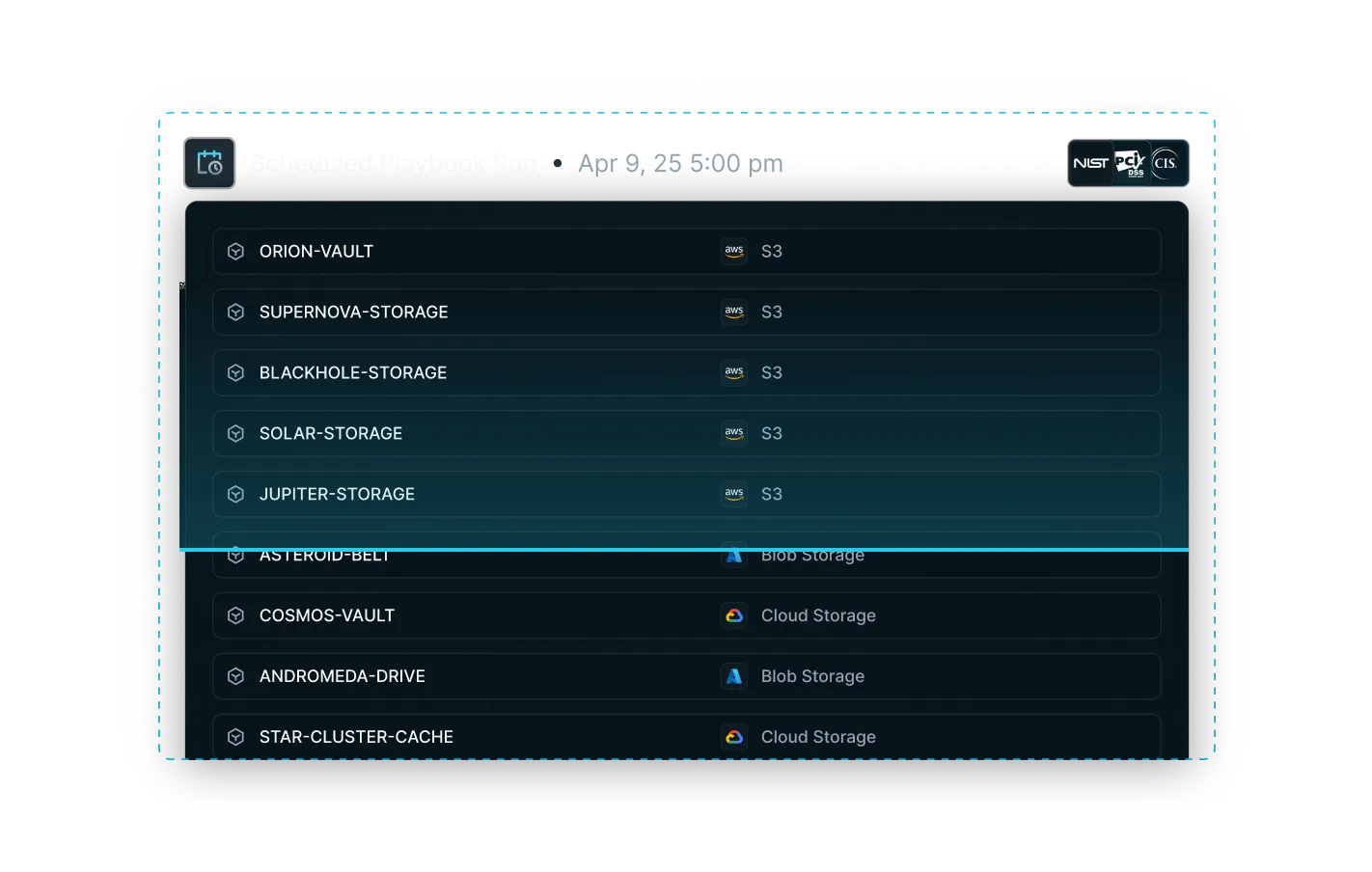
Instead of confirming a control passes today, confirm it passed on every evaluated day between two dates. Drift inside the period surfaces as a gap with a date attached, which is the answer to the question an auditor is actually asking.
Time Machine assembles the evidence package with configuration state, timestamp, and actor. Every export is hashed and carries a verification endpoint, so an assessor or counterparty can independently confirm nothing was altered after the fact. This is the part no GRC workflow tool can produce, because they record that a check passed rather than the configuration that made it pass.
The analyst who owns the control pulls the evidence
Scoped, read-only views across every cloud account, with the saved queries that answer the requests you get every cycle.
What audit-ready evidence covers
The capability on the left, who stops waiting on engineering on the right.
imPAC produces and proves the cloud configuration evidence. Keep your GRC platform for workflow, policy documentation, and the controls that do not live in cloud configuration. imPAC generates the evidence those tools check as a boolean.
“Our audit used to be a quarter long scramble. The hard part was never meeting the controls, it was proving they held six months ago. Now the analyst who owns the control pulls the evidence herself, and the export is something our assessor can verify without taking our word for it.”
-Director of GRC, Bank
What audit-ready evidence means for your team
Evidence on demand
The question “was this in place on March 15” takes seconds instead of a forensic dig through logs.
Engineers stay on roadmap
GRC stops opening tickets for evidence. Senior engineers stop leaving delivery work to run one-off scripts.
Proof an assessor cannot dismiss
Hashed exports with a verification endpoint replace screenshots that carry no provenance.
One inventory, many frameworks
A new framework means new controls inside the platform you already run, not a new platform to buy and staff.
Progress you can show a board
Compare posture between any two dates and show what actually improved, with evidence behind each claim.
Reusable by design
Define the playbook once. Every future audit cycle reuses it instead of rebuilding the process.
Frequently Asked Questions
Does this replace our GRC platform?
How far back can we go?
What makes the export tamper-evident?
Can we map our own internal standards, not just published frameworks?
Who needs access for this to work?

See your evidence cycle in one session
Bring a control your auditor asked about last cycle. We will show you the configuration behind it, its state on the date they asked about, and what the sealed export looks like.